
A healthy balance between antioxidants and ROS is essential for good health. Natural astaxanthin is recognized as one of the most powerful antioxidants, helping support oxidative balance
Every day, our bodies produce reactive oxygen species (ROS) as a natural by-product of metabolism. In normal amounts, these molecules play important roles in cellular signaling and immune function. However, when ROS production exceeds the body’s antioxidant defenses, oxidative stress can occur. Over time, this imbalance may contribute to cellular damage and affect overall health and wellbeing. [3,4]
Lifestyle and environmental factors such as poor diet, pollution, tobacco smoke, excessive sun exposure, psychological stress, sedentary behavior, and intense physical activity can all contribute to increased ROS production. [2]
What are Reactive Oxygen Species and How Do They Cause Oxidative Stress?
Reactive oxygen species (ROS) is a collective term that includes not only oxygen-centered free radicals, but also some non-radical derivatives of oxygen. ROS, otherwise known as pro-oxidants, are formed as by-products of normal metabolism in our body when food is converted into energy.[3] Immune cells fighting bacterial infections also release ROS.[4] Additionally, we encounter ROS in many other aspects of our daily lives in response to the aforementioned lifestyle and environmental factors.
There is a growing consensus that ROS play a dual role and can be either harmful or beneficial to living systems.[3] Beneficial effects of ROS occur at low/moderate concentrations and involve physiological roles in cellular responses to danger, such as immune cells defending against infectious agents. Low to moderate concentrations of ROS can serve as signals in important pathways involved in normal cell activities.
High levels of ROS can initiate harmful alterations in key biomolecules, such as lipids, proteins and DNA in a condition called oxidative stress. Oxidative stress occurs in the body when there is an overproduction of free radicals and ROS on one side, and a deficiency of antioxidants on the other (Figure 1 A, B, C). The efficiency of body’s own antioxidant defense system reduces as we age (Figure 1B), while the overproduction of free radicals/ROS can take place at any point in life, and particularly in response to certain lifestyle and environmental factors (Figure 1C).
It is estimated that each cell in the body forms more than 20 trillion ROS per day through normal metabolism, and that each cell may be attacked by these reactive molecules 10,000 times per day[5] Over time, oxidative stress can damage cells and tissues, leaving them unable to function properly. Notably, overproduction of ROS impairs biological systems either directly – by oxidation of cellular lipids, proteins, and DNA, or indirectly – by disrupting normal physiological signaling.[6]
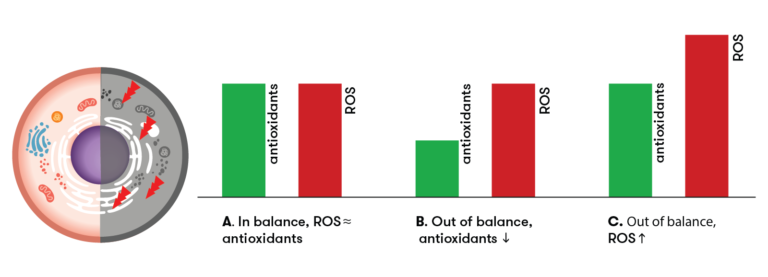
In a normal healthy human body, the generation of ROS and other free radicals is kept in check through antioxidant defenses. However, when the body is exposed to adverse physicochemical, environmental or pathological stressors, this delicate balance is shifted in favor of pro-oxidants, and results in oxidative stress. Oxidative stress accompanies most, if not all, pathological conditions, including cardiovascular, immunological and neurological disorders,[7, 8] diabetes[9] and male infertility.[10] Oxidative stress is also closely linked to premature aging.[11]
How Does the Antioxidant Defense System Work?
The antioxidant defense system of the body is a complex network which comprises several enzymatic and non-enzymatic antioxidants.[12] Enzymatic antioxidant defenses include superoxide dismutase, glutathione peroxidase, and catalase. There are also several non-enzymatic antioxidants, including vitamins C and E, selenium, and carotenoids such as β-carotene, lycopene, lutein, zeaxanthin and astaxanthin. Among these, natural astaxanthin stands out as one of the most powerful, thanks to its unique ability to position itself within the cell membrane.
Dietary intake is an important source of these non-enzymatic antioxidants. They function as chain-breaking antioxidants, working in tandem with enzyme antioxidants to temper ROS to within physiological limits. Low intake or impaired availability of dietary antioxidants weakens this important antioxidant network.[13]
Protective antioxidant compounds are located in organelles, subcellular compartments and in extracellular spaces enabling maximum cellular protection to occur. The components of the antioxidant network play specific roles in different parts of the cell, depending on whether they are water-soluble or lipid soluble.
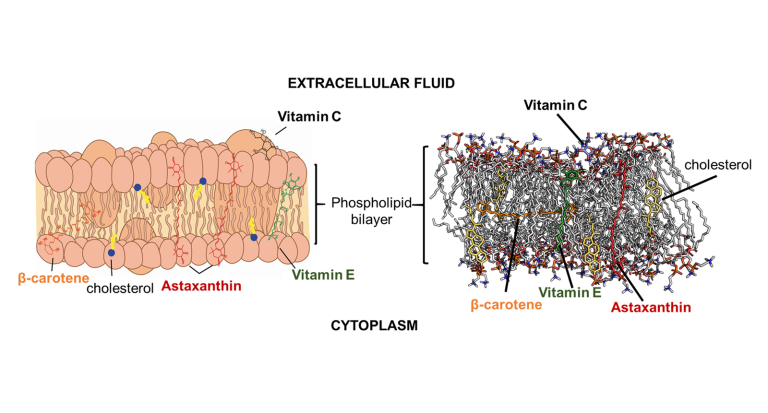
For example, water-based vitamin C and glutathione protect cytosol and/or the cytoplasmic matrix. The lipid-soluble antioxidants, including vitamin E and carotenoids like β-carotene and astaxanthin, are predominantly located within cell membranes.
Among these antioxidants, natural astaxanthin is recognized for its unique molecular structure, which allows it to span the cell membrane and provide protection both inside and outside the membrane. This distinctive positioning contributes to its exceptional antioxidant activity and its ability to support the body’s natural antioxidant defenses.
Why Maintaining Oxidative Balance Matters
Maintaining oxidative balance is essential for normal cellular function throughout life. A healthy antioxidant defense system helps protect cells from excessive oxidative damage while allowing ROS to continue performing their important biological roles. Oxidative stress is a natural part of everyday life, but when ROS production consistently outpaces the body’s antioxidant defenses, it can contribute to cellular damage and affect long-term health. Supporting the body’s antioxidant defenses through diet and targeted supplementation is one of the most effective ways to help maintain this balance. Natural astaxanthin is one such antioxidant, shown to be 6,000 times more powerful than vitamin C at neutralizing ROS.[14]
Explore more articles in our Health Benefits section to discover how natural astaxanthin supports healthy aging, muscle recovery and eye health and more.
References
2) Krumova, K. and G. Cosa, Singlet Oxygen: Applications in Biosciences and Nanosciences, 2016. 1, 1-21.
3) Valko, M., D. Leibfritz, J. Moncol, et al., The International Journal of Biochemistry & Cell Biology, 2007. 39, 44-84.
4) Belikov, A.V., B. Schraven and L. Simeoni, J Biomed Sci, 2015. 22, 85
5) Niyogi, K.K., O. Bjorkman and A.R. Grossman, Proc.Natl. Acad.Sci.U.S.A, 1997. 94, 14162-14167.
6) Schieber, M. and Navdeep S. Chandel, Current Biology, 2014. 24, R453-R462.
7) Fassett, R.G. and J.S. Coombes, Future Cardiol, 2009. 5, 333-42
8) Patel, M., Trends in Pharmacological Sciences, 2016. 37, 768-778.
9) Maiese, K., Oxidative Medicine and Cellular Longevity, 2015. 2015, 875961.
10) Ko, E.Y., E.S. Sabanegh, Jr. and A. Agarwal, Fertility and Sterility, 2014. 102, 1518-1527.
11) Shigenaga, M.K., T.M. Hagen and B.N. Ames, Proc Natl Acad Sci U S A, 1994. 91, 10771-8.
12) Sies, H., Eur J Biochem, 1993. 215, 213-9.
13) Sies, H., W. Stahl and A. Sevanian, The Journal of Nutrition, 2005.135, 969-972.
14) Nishida, Y., E. Yamashita and W. Miki, Carotenoid Science, 2007. 11, 16-20.