
Astaxanthin is a membrane-spanning antioxidant, uniquely able to protect cells from the inside out, making it one of the most powerful antioxidants known.
Antioxidants help to keep a healthy oxidative balance. A diverse range of oxygen free radicals and other reactive oxygen species (ROS) can be formed in the human body. The interplay between ROS and antioxidants is critical in maintaining good health. If the ROS generated exceeds the protective effects of antioxidants, it can cause oxidative stress – a deleterious process, damaging cell structures, including lipids, proteins, and even DNA. Many people do not get adequate levels of antioxidants from food alone. Supplementation with dietary antioxidants helps support the body’sown antioxidant defenses and controls the harmful effects of excessive ROS.
Astaxanthin is a naturally occurring carotenoid with a unique chemical structure and cell membrane actions. It is a powerful antioxidant and highly effective at counteracting ROS. Astaxanthin has the unique ability to span the cellular membrane and trap ROS within the membrane’s interior, and along its surface boundaries. Astaxanthin neutralizes ROS without becoming a pro-oxidant in the process. Clinically, astaxanthin has shown diverse health benefits, while also demonstrating excellent safety and tolerability
How do Antioxidants Support Health and Well-being?
Balanced nutrition is a key lifestyle factor that helps support general wellness. Antioxidants are natural substances that help to prevent the harmful effects of excessive ROS activity, and combat or delay cell damage. Nonetheless, the calorie-rich and nutrient-poor diets of many people today, can make it challenging for them to get enough of essential micronutrients, such as vitamins, minerals, and antioxidants. Malnutrition and poor diet are the biggest drivers of the global burden of disease.[1] Furthermore, exposure to pollutants, excessive sunbathing, tobacco smoke, stress, sedentary lifestyle, extreme exercise, and the use of certain medications can all contribute to an excess of ROS,[2] and potentially have a destructive impact on health and wellbeing.
How is Astaxanthin Superior?
Natural astaxanthin is considered as a “superior antioxidant” because of its unique chemical properties based on the molecular structure and localization within the cell membrane.
While structurally similar to the carotenoid β-carotene, astaxanthin has thirteen conjugated double bonds, whereas β-carotene has eleven. In the cyclohexene structure, it has oxo groups in the fourth and fourth prime positions. The antioxidant activity of carotenoids depends on the length of the electron rich, conjugated, double bond system. An extension of the conjugated double bond system increases the potency of astaxanthin compared to β-carotene and vitamin E.[3] Additionally, astaxanthin has hydroxyl groups at the third and third prime position, making the molecule somewhat polar.
The antioxidant properties of various antioxidants in vivo are strongly influenced by how they interact with the membrane bilayer, their orientation, and location within the membrane. Nonpolar carotenoids (i.e.: β-carotene and lycopene) are located between membrane bilayers and therefore may disrupt the intermolecular packing of the phospholipid molecules.[4, 5] By contrast, polar astaxanthin spans the membrane, with its polar end groups extending toward the head group regions of the membrane bilayer. Astaxanthin position does not modify the structure of constituent membrane lipids[4-6] (Figure 2). As a result, astaxanthin acts as a chain- breaking antioxidant by stopping free radical chain reactions and scavenging lipid peroxyl radicals. Furthermore, since astaxanthin spans the cell membrane bilayer, its terminal rings can effectively scavenge ROS on the membrane surface, while its polyene chain is responsible for trapping ROS in the interior of the membrane.[6]
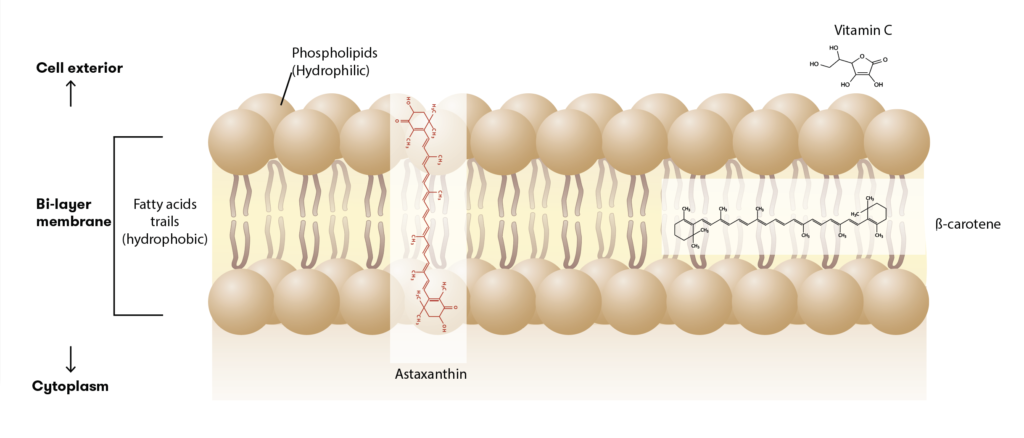
Astaxanthin can use different methods to prevent oxidative stress. Astaxanthin counteracts potentially harmful free radicals/ROS by trapping energy (quenching) and the transfer of electrons, or through hydrogen abstraction (scavenging). [3, 7-10] Energy from the high-energy ROS compounds can be transferred to astaxanthin by direct contact, and that energy is converted to heat.[3] In this process of quenching, astaxanthin remains intact so that it can undergo further cycles of singlet oxygen quenching. Singlet molecular oxygen is a strong pro-oxidant that displays substantial reactivity towards DNA, proteins, and lipids.[11]
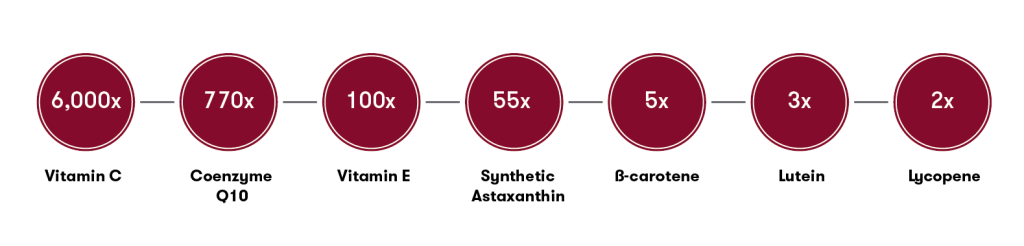
Comparative studies have shown that natural astaxanthin is 6,000 times more powerful than vitamin C, 100 times more powerful than vitamin E, and five times more powerful than β-carotene in its ability to trap energy from singlet oxygen[9] (Figure 3). Furthermore, astaxanthin reacts as a strong antioxidant without any pro-oxidative nature.[12, 13] Consequently, astaxanthin is gentle on the body’s cells as it effectively neutralizes harmful ROS.
Conclusion
Astaxanthin stands apart from other antioxidants because of its unique chemical properties, its ability to span the cell membrane and neutralize ROS with a potency far exceeding vitamin C, vitamin E, and β-carotene, all without acting as a pro-oxidant.
A growing body of clinically-validated research points to benefits across a range of target groups, from young, highly-trained athletes with increased ROS production, to healthy middle-aged and senior adults with weakened antioxidant defenses. This has made natural astaxanthin a valuable functional ingredient of growing interest for cardiovascular, cognitive, eye, joint, and skin health, as well as healthy aging.
References
- Global Nutrition Report 2016, 2016.
- Krumova, K. and G. Cosa, Singlet Oxygen: Applications in Biosciences and Nanosciences, 2016. 1, 1-21.
- iki, V., Pure & App. Chem., 1991. 63, 141-143.
- McNulty, H., R.F. Jacob and R.P. Mason, American Journal of Cardiology, 2008. 101, S20-S29.
- McNulty, H.P., J. Byun, S.F. Lockwood, et al., Biochim Biophys Acta, 2007. 1768,
- Goto, S., K. Kogure, K. Abe, et al., Biochim Biophys Acta, 2001.1512, 251-8.
- Martinez, A., M.A. Rodriguez-Girones, A. Barbosa, et al., J Phys. Chem.A, 2008. 112, 9037-9042.
- Mortensen, A., L.H. Skibsted, J. Sampson, et al., FEBS Lett., 1997.418, 91-97.
- Nishida, Y., E. Yamashita and W. Miki, Carotenoid Science, 2007. 11, 16-20.
- Shimidzu, N., M. Goto and W. Miki, Fisheries science, 1996. 62, 134-137.
- Cadet, J., T. Douki, J.-P. Pouget, et al., 2000, Academic Press
- Martin, Ruck, Schmidt, et al., Pure Appl. Chem., 1999. 71, 2253-2262.
- Beutner, S., B. Bloedorn, S. Frixel, et al., Journal of the Science of Food and Agriculture, 2001. 81, 559-568.
Explore more articles on our Health Benefits page about how natural astaxanthin supports health.