
A creative exploration of the unique challenges faced by SOP authors, and suggested methods to improve SOP clarity and effectiveness to support quality in manufacturing.
A Sandwich-Making Challenge
Imagine you’re taking part in a contest. You’ve been paired with a trustworthy stranger, who must make peanut butter and jelly sandwiches in your kitchen while wearing a blindfold and a headset. This is the only information they have. You, meanwhile, are stationed outside your home and must use only your verbal instruction through that headset to guide this person through the simple task. You are told that you have 15 minutes, and that points are awarded for number of sandwiches made, consistency between sandwiches, and least amount of kitchen mess. Whichever pair of contest participants makes the greatest number of the most consistent PB&J sandwiches with the least amount of waste, wins the grand prize. What difficulties would you encounter?

What would make your role easier? What strategy would you employ to increase your chances of success?
Minus the culinary theme and the daunting prospect of having a complete stranger in one’s beloved home, this is the same challenge that authors of Standard Operating Procedures face when they set to writing. Who are the readers? What level of knowledge do they posess about the process? How familiar are they with the materials? Do readers know which tools are most appropriate and how to utilize them safely?
SOP authors are often not possessed of this information, yet they are responsible for communicating instruction in such a way that all team members can execute the procedure within a very small margin of acceptable variability. Fortunately for authors, there are a few guidelines that make the challenge more manageable:
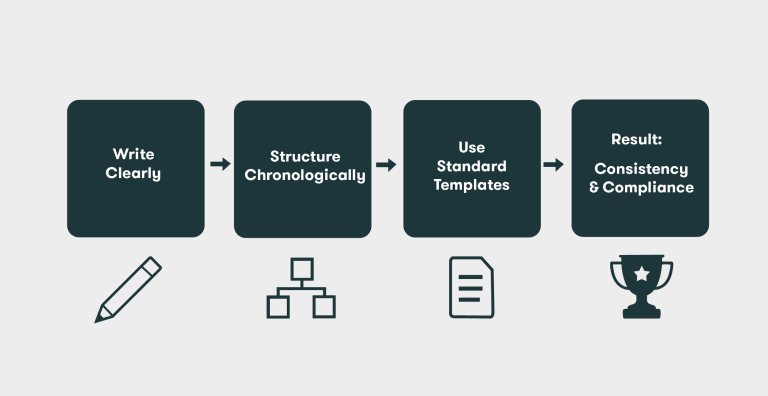
Write such that readers can execute tasks as they follow along;
A well-written SOP should be designed so that information and instruction is provided in the text where and when it is needed in the process. This means providing process steps in a chronological sequence; step-by-step, in order of performance.
This objective can be supported by limiting the use of time-related words, and maintaining an active voice throughout instruction. An SOP author must notice how and when time-related words such as “before”, “after”, “during”, etc. are employed. If such words are used to clarify when to perform a given action, the author may consider rearranging the information so that action cues can be performed by the operator as they appear in the text. Additionally, an author must be aware of the voice used throughout the document. The imperative form of verbs should be used to clearly direct the reader on what to do next, rather than stating in a passive voice what must be done. An SOP should not be about what must be done, it should be the sequentially-ordered list of things to do.
To illustrate, telling your trustworthy stranger that “Before the sandwich is cut in half, it needs to be assembled” is vague and thus more likely to result in inconsistently assembled and cut sandwiches and deducted points than if you were to tell them to “Assemble the sandwich so that the corners of the bread slices are aligned, and condiments are on the inside. Then, cut the sandwich in half from the top-left to bottom-right corners”. Make sure to give your reader the instruction when and where they need it to ensure your team’s success.

Write with consistent wording in standardized templates;
An SOP should be consistent within itself, and with other SOPs. This means using the same language to convey the same meaning, and standardizing the way information is presented within the document.
This objective can be supported by using consistent naming for equipment or materials. Likewise, using command words such as “may”, “must”, and “should” in a consistent and clear manner. An SOP author should be clear on names and terms, and use them in the same way every time, and perhaps define terms in a definitions chapter within the SOP.
Additionally, using a standardized template for every SOP provides predictability and enhances readability by separating supporting information from instruction. Standardized templates allow non-instructive sections of the document to be organized for efficient delivery of necessary supporting information. For example, a purpose chapter can be used to communicate why and how a process is important to the overall goal of the facility. A scope chapter will contain information about who or what the process applies to. A responsibilities chapter highlights which personnel perform which parts of a process, as well as who is responsible for the process as a whole. Using chapters in this way prevents the supporting information from clogging the flow of the instructional portion of the document, the procedure chapter.
To illustrate, you would need your trustworthy stranger to know that messy sandwich production may jeapordize your chances of winning so that they can be careful throughout the contest. The best opportunity to communicate this information would likely be before starting, not while they are in the middle of applying the jelly. Make sure to organize information and instruction in an efficient and digestible way to ensure your team’s success.
Conclusion: The Value of Well-Written SOPs
Of course, in the manufacturing world, operators have the benefit of much more support than does the trustworthy stranger in the PB&J contest. SOPs are not meant to stand alone, but be supported by robust training and education programs. However, SOPs are the foundation of every day-to-day task on the production floor, and may be the only interface some workers have with matters of compliance. SOPs are therefore a critical factor in any production facility, and if they’re written well, the facility stands a much greater chance at success.
The grand prize? Increased productivity and compliance, reduced loss from waste or defects, and consistent, high quality product – every manufacturing facility’s bread and butter.
Learn about why Algalíf is committed to exceptional quality, purity, and sustainability by visiting our “Why Algalif” page. It provides deeper insight into our closed, sustainable production system and the principles that guide our approach to producing natural astaxanthin and other health-promoting ingredients: